

What do you get when you mix together a beastly cryptid, a bestselling book creator, and a chortle-out-loud series of graphic novels? The answer is likely Dan Santat’s new series featuring Fishboy, the oddball newcomer to school. Santat, the winner of a National Book Award, a Caldecott Medal, and an Eisner Award, launched his new series in April 2026 with A Fishboy Named … Sashimi (Roaring Brook Press). He followed that up with even more chuckles in September, with Sashimi and the Field Trip of Doom (Roaring Brook Press). And Sashimi: Double Trouble (Roaring Brook Press), slated to come out in April 2027, is bound to add more zany characters to the likes of Poopdeck Pete and the Beast of Barnacle Bay (a mysterious creature who maybe wants to eat kids).
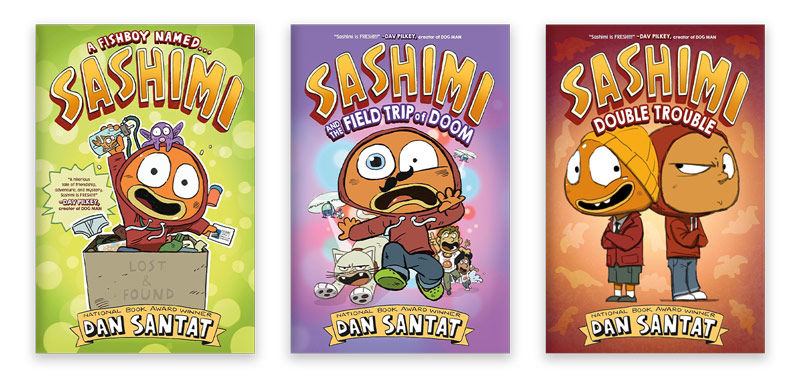

Here, Santat talks with Lisa Bullard about insider details (spoiler alert) on this new graphic series, why he’s such a fan of writing funny stories, and his advice for young people who want to follow their dreams.
What prompted you to share Fishboy’s adventures?
I was at San Diego Comic Con. I saw someone cosplaying as a fish character of some sort, and I was drawn to the dead stare of the eyes, wondering, What is the person thinking under that outfit? It really was as simple as that. I’ve always been enamored by urban legends and cryptids, and throughout the con I just started imagining a sea creature pretending to be a comic con attendee blending in with everyone else, and that’s how Sashimi was born. My friends Mo Willems and Dav Pilkey had asked me over many years why I had never started a series of my own, and here I was entering my fifties, and I realized it’s now or never.
What are the challenges/payoffs of writing a funny series?
By default, I’m just a funny person by nature, so humor comes naturally to me. I like to make people laugh. I like to make people feel good, especially when everyone is so down on the world. The one challenge is questioning what adults perceive is appropriate for kids, and it’s a broad spectrum. I sharpened my wit by reading MAD Magazine as a kid, and I think about the inappropriate books we all read as kids, (Stephen King, Flowers in the Attic, etc.), and I think how despite all that, the majority of us turned out to become well-minded adults. I found the recent research that reading has gone down 40% in the last twenty years to be quite discouraging, and I really wanted to create something that kids would want to inhale simply because it is fun.
I like to make people laugh. I like to make people feel good, especially when everyone is so down on the world.”
What made you decide to mix some factual information in with highly relatable sixth-grade hijinks?
Mixing in factual information is sort of a play on the old Standards and Practices of 80s television, where the FCC insisted that there be some educational value in cartoons, and so you would watch an episode of GI Joe, and in the last few minutes they’d show a little short saying, “Don’t jump over live electrical power lines! And knowing is half the battle!” and it would suffice. Other times, I’ll put facts in the book because I may be telling a joke to kids that is actually directed toward their adult parents and teachers, and I need to fill in some information for the kids to understand. These books aren’t just for kids; I want everyone of all ages to enjoy these books.
What process did you go through to create not only a complete cast of quirky characters but also a whole new town with its own urban legend?
I used The Simpsons as a template. The brilliance of that show is that the entire community of Springfield is filled with colorful and unique characters. It broadens your spectrum in terms of what you’re allowed to do with jokes and characters, but what I especially love is that Sashimi is merely a symbol of an entirely fun community of unique characters, so the laughs can come from anywhere.
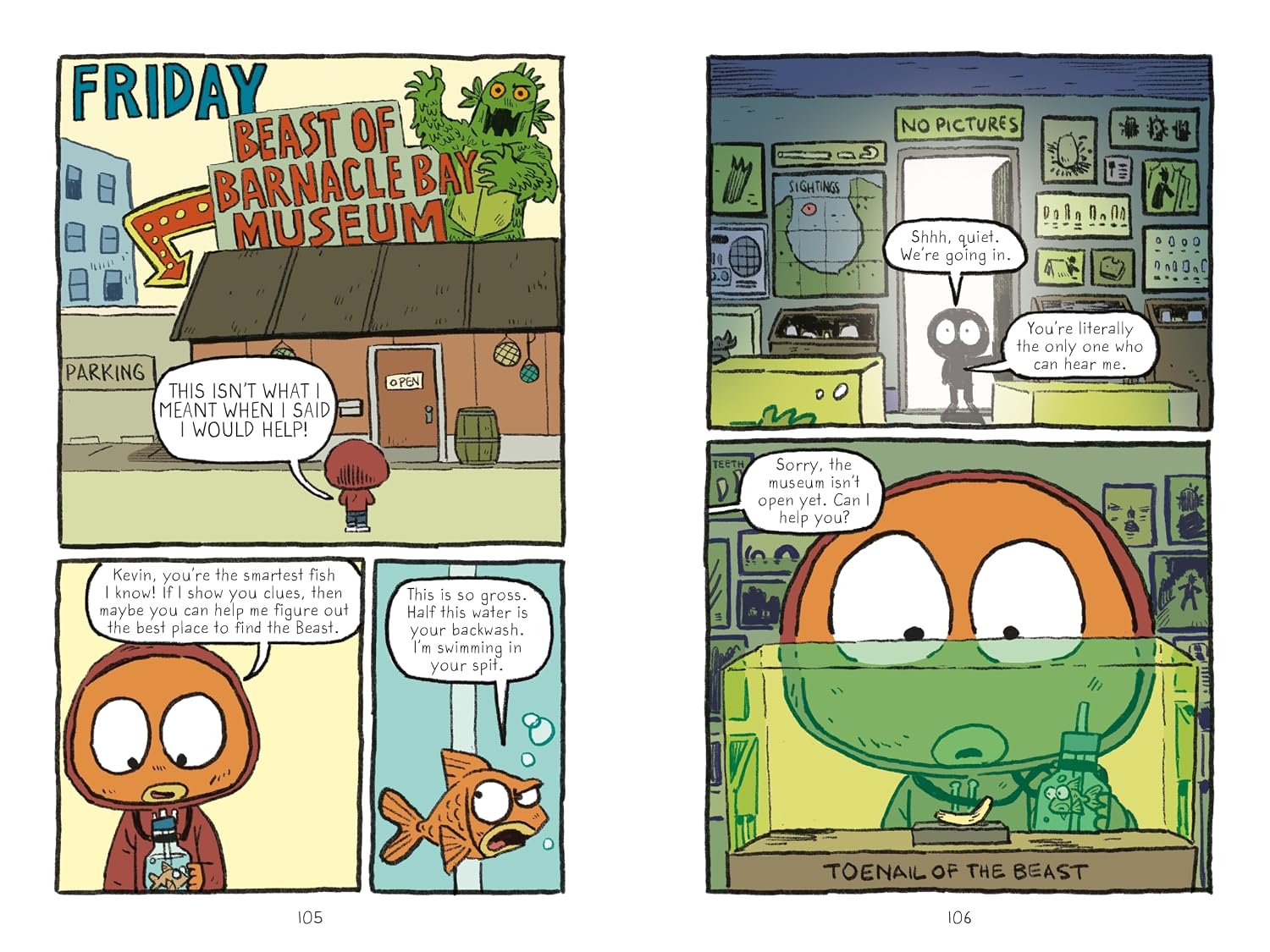
Spread from A Fishboy Named . . . Sashimi
The rumors about the Beast of Barnacle Bay—the town’s urban legend—add another layer of fun to the series. What’s your own favorite urban legend/mythical creature?
I love all urban legends. I used to read books about Bigfoot, hoping it was real. In a world where we’ve covered the globe with GPS satellites, I like to believe that there are still hidden treasures right under our noses.
I love all urban legends. I used to read books about Bigfoot, hoping it was real.”
Did you know from the beginning where you wanted to take the series as a whole?
I began with an overall story arc because I feel that there always has to be a broad storyline that ties all the stories together and that needs answers as you progress throughout a series. Does Sashimi find the Beast of Barnacle Bay? Yes. But then what, and what happens afterward?
I try to talk about many of the social issues that families and kids experience in their lives. Things like parent pickup lines after school, teachers holding second jobs so they can buy school supplies for their classrooms, etc. These are all things we can relate to, and I try to give them a humorous twist, but these jokes also lie within the broader story arc. As we progress through the series, we will see that back stories and inside jokes are a huge thing too. As people read these books, they’ll see me referencing jokes from Book One and reused in Book Four or Five, and someone who has been a fan of the series will get the joke because they’ve become invested in the entire world.
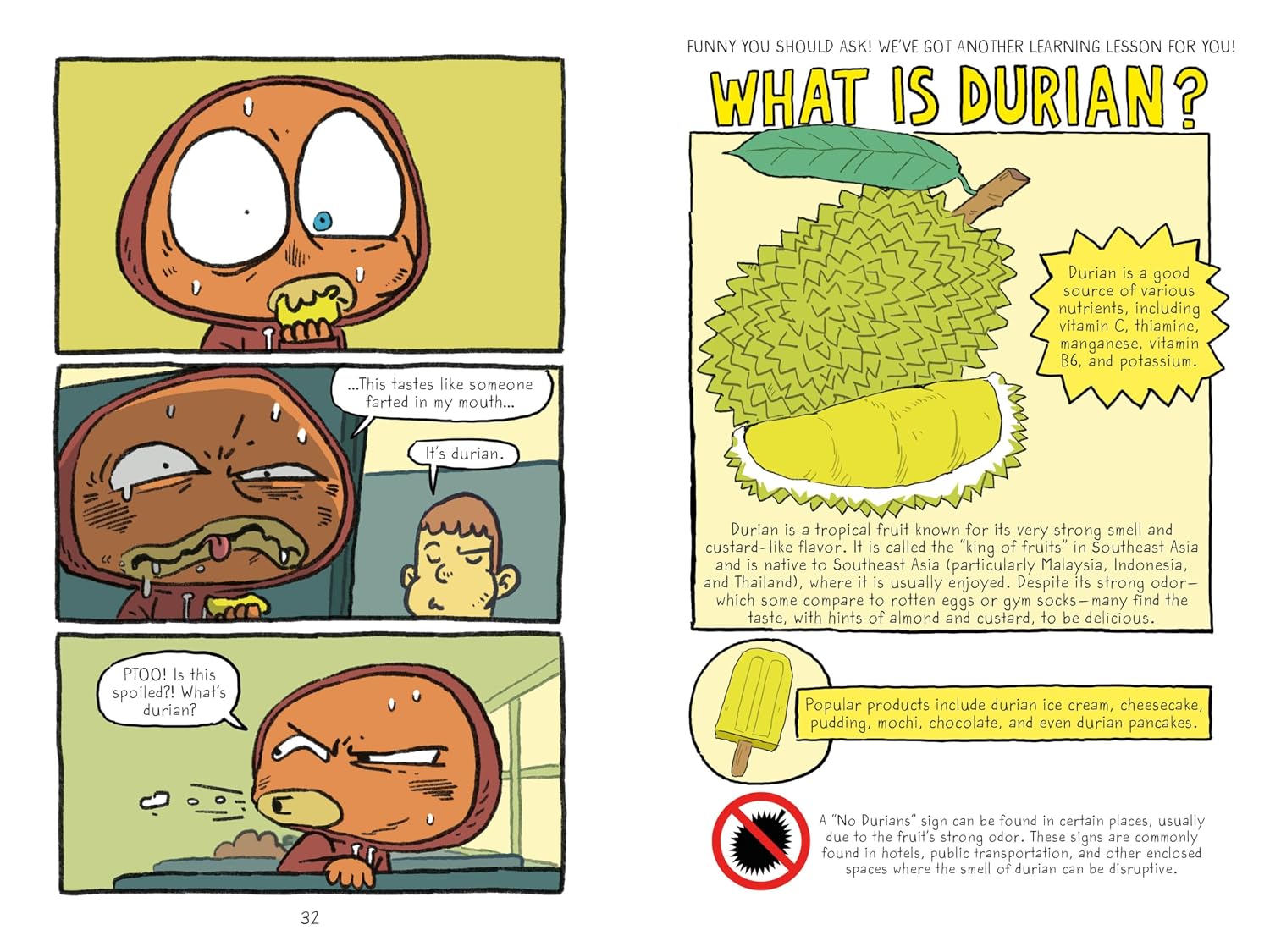
Spread from Sashimi and the Field Trip of Doom
Have big surprises emerged for you as you’ve worked on these books?
There is a huge revelation at the end of Book Three that I planted, not realizing what I would eventually do with it, and now I’ve pieced it back into Book Five, and it plays an important role in setting up Book Six. I’m over a year ahead of everyone else in terms of knowing all the details of the storyline, and I can’t wait to see everyone’s reactions when the answers come to fruition.
Can you tell us anything else about what’s up next for Sashimi?
I’m not sure what I can tell you, but throughout the series I’ve used certain story genres as the backbone for each book. Book One was the introduction story: the new kid in town who tries to fit in. Book Two is modelled after The Fugitive. Book Three is The Parent Trap/The Prince and the Pauper. Book Four is Scooby-Doo/Glass Onion. Book Five is a zombie apocalypse. Book Six is actually going to be a David vs. Goliath story, which may or may not be a little more emotional. You find out some secrets about their teacher, Miss Wilcox. The wrestler who appears in the first two books makes a surprise appearance as a substitute teacher. Someone in town might actually be half sea creature. The school bathroom pass is a wooden leg with a long history that is tied to the town. Someone in town is actually a cyborg! There’s a clown gang! All gloves are off, and I’m here to make everyone laugh.
What advice would you give to young people who want to create their own graphic story?
There is no right or wrong. Just do it. Start small and don’t be too ambitious. You need to have the confidence to know you can actually finish a story. The rougher the better, but you learn every time you make one, and the best part of it all is that I feel the comic medium is a format that really shows your unique voice.
I feel the comic medium is a format that really shows your unique voice.”
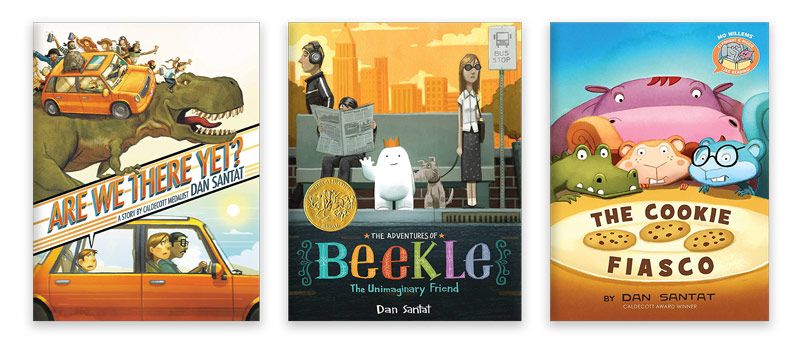
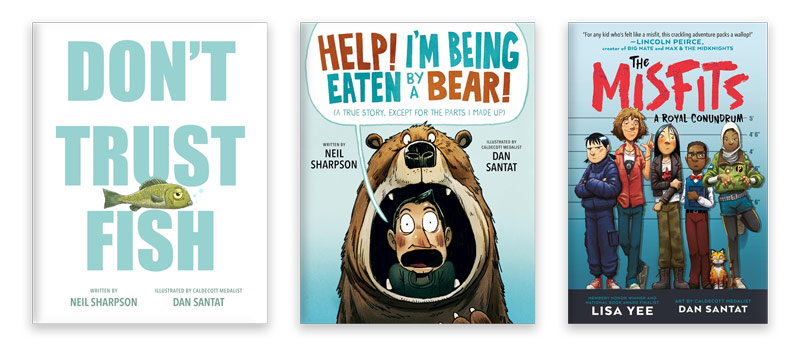
Along with graphic novels, you’ve also illustrated many picture books. How would you compare/contrast the process of creating these two kinds of illustrated books?
I’m less precious with a graphic novel than with a picture book. What I mean is that with a picture book you’re illustrating 32 pages of a book while with a graphic novel, you’re drawing hundreds of panels throughout, upwards of 200 pages. If I were to be as meticulous with a graphic novel as I am with a picture book, it would take me forever to complete. With a graphic novel you can settle with “good enough,” which I think has actually been a benefit to my work because it loosens me up, and I can see more of the human touch in it all.
What’s your favorite part of creating books for young readers?
I get to write and draw all this absurd stuff and call it a job.
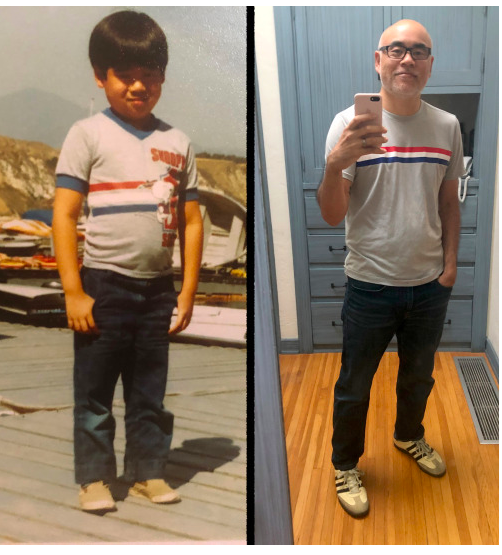
Dan Santat as a child and Dan Satant on his birthday October 2, 2020
How did your childhood contribute to your dream of writing?
I had a few close friends. A solid four to eight friends who I could always rely on. It doesn’t take much to get you through the tough years of adolescence; you really only need one or two. They were the ones who saw potential in me that I didn’t see in myself. They were the ones scratching their heads, asking, “Why aren’t you pursuing art? You’d be so good at it.” And over the years they were the ones who wore me down until I finally decided to apply to art school, and once I got in, I never looked back. Your friends know you better than you may even know yourself.
What advice do you have for young people who want to follow a dream?
Make sure that you never lose the love of achieving that dream. In other words, don’t take it so seriously that the dream becomes work. All my life my parents wanted me to become a doctor, and writing and illustration never felt like it was in my future, so I always viewed it simply as a hobby. You’re more open to experimentation when you do a hobby because nothing ever feels precious. It just brings you joy doing it. I never studied writing and illustration as a means to an end of becoming a writer. I pursued that knowledge because I wanted to improve my own work out of self-satisfaction. Making mistakes was never an issue because as a “hobbyist,” you never take yourself seriously until one day it becomes a reality, and suddenly you realize that because of all the years you spent doing something you love, you had spent years preparing yourself for just that moment.
Do you have a favorite anecdote about the way a young fan has responded to one of your books?
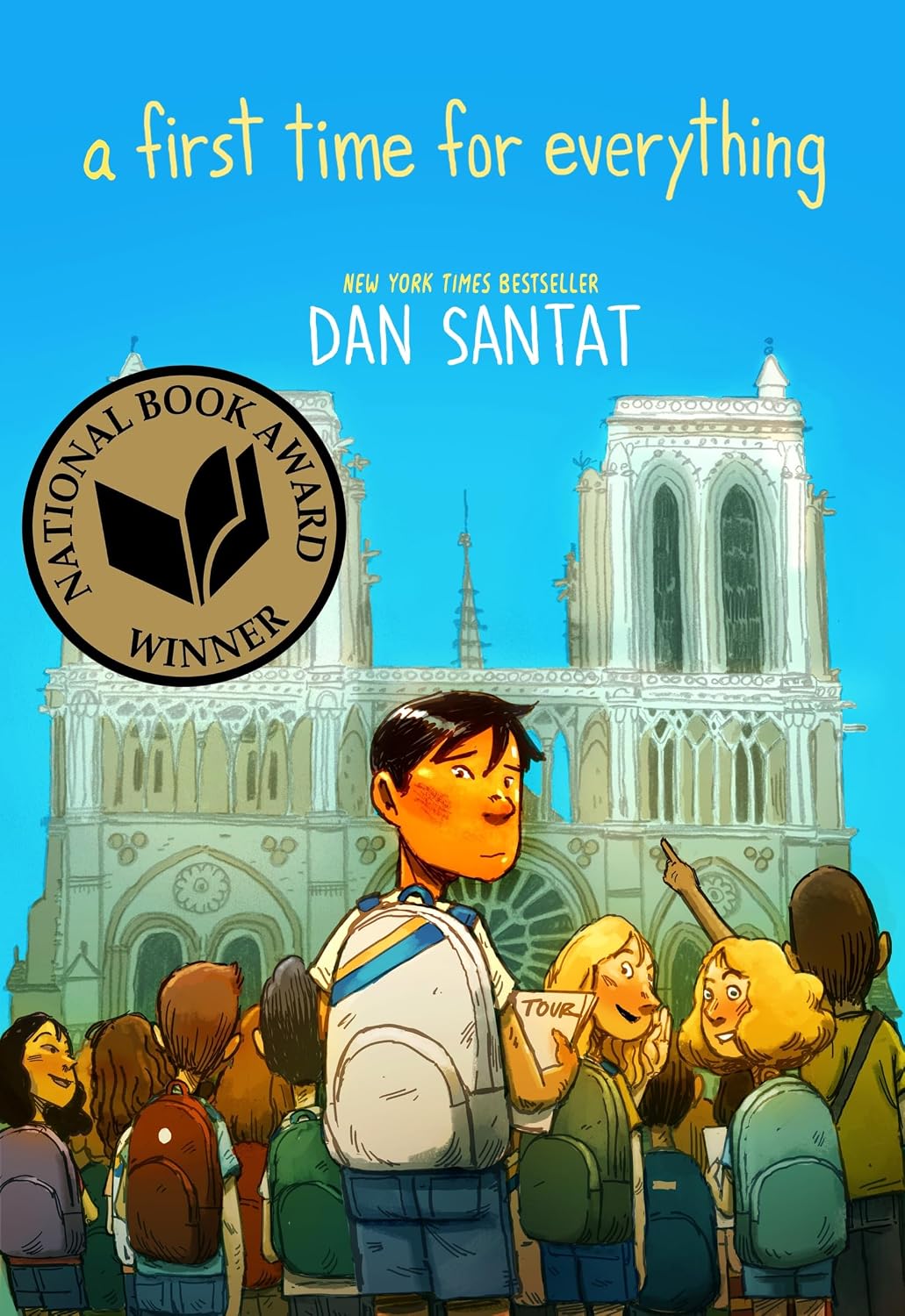
After the release of A First Time for Everything (First Second, 2023), I started getting direct messages from kids on my Instagram account, which is something that never happens with picture books. One kid a few months back asked me directly, “What does it feel like to fall in love?” Now, I’m careful about how I address these kids, mainly because it’s probably not my place to give them any life advice because I’m a complete stranger. That sort of conversation should probably be had with a parent or a close relative or a friend. The fact that the kid felt such a deep connection to me after reading my book really touched my heart. The kid engaged with my character so much that he saw himself and was genuinely curious about my feelings as if I was their friend. I wrote the kid back and said, “I don’t want to spoil anything because it’s very special, but when you fall in love, I promise you that you’ll know it.”
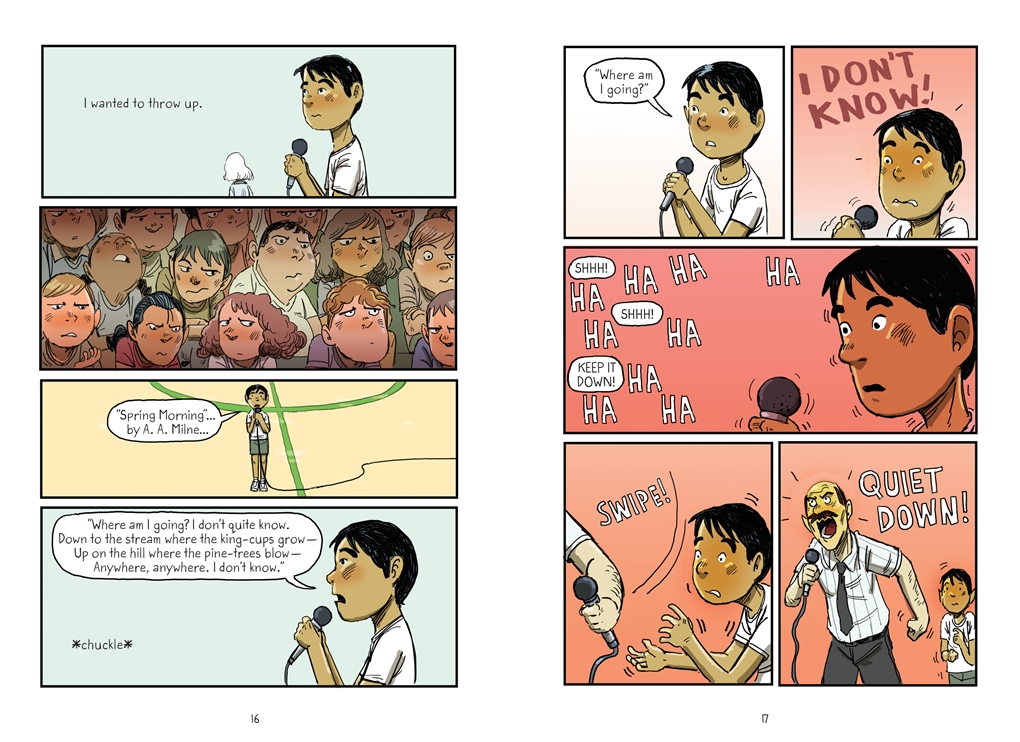
Spread from A First Time for Everything
The kid engaged with my character so much that he saw himself and was genuinely curious about my feelings as if I was their friend.”
What are the best ways for educators and librarians to connect with you or to follow you on social media?
I think these days I’m best found on Instagram @dsantat, but I’m also on Facebook, X, and Bluesky under the same name.