
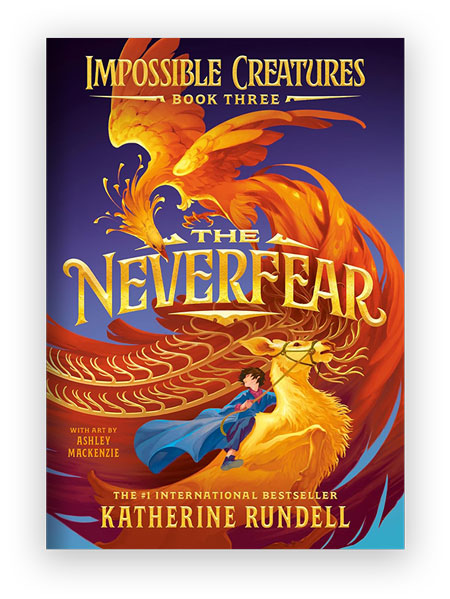
The Neverfear (Knopf Books for Young Readers, September 1, 2026), returns readers to “the last surviving magical place.” This is the extraordinary realm Katherine Rundell introduced in the award-winning title Impossible Creatures (Knopf Books for Young Readers, 2024) and expanded upon in The Poisoned King (Knopf Books for Young Readers, 2025). The Neverfear introduces enthralling new details to the bestselling Impossible Creatures universe. But it also carries on the series standard by structuring everything around sweeping action and adventure, relatable characters, deepening friendships, mythological creatures, and humorous moments that lighten sometimes-dark developments. Rundell once again empowers her young characters to take action, even when facing true danger, and trusts that young readers are capable of grappling with complex themes and emotionally challenging choices.
Here, Rundell talks with Lisa Bullard about writing as a process of discovery; creating a fantasy world; and how young writers can build a fantasy world of their own and follow their dreams.
What did you most want to accomplish with this new addition to your fan-favorite Impossible Creatures series? What newly introduced element was your personal favorite?
I wanted, most of all, to try to write an adventure that would be exciting and vivid and fresh and funny enough to keep my readers from the first page to the last. That seems to me the most important thing a book for young people can do, to tell a story they want to hear and that salutes how clever they are.
Of the new elements, I loved writing the tasks. The plot involves a kidnapping, and three objects are demanded in exchange. I loved telling the story of how my young heroes get the ransom. And I loved writing the new villains, who have been just hinted at in other books; I love the drama of villainy.
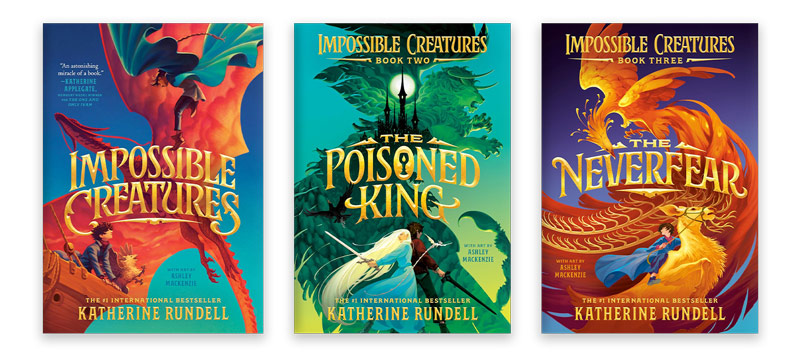
I’ve read that you planned five titles total for the series, which sets up The Neverfear as the middle book in this epic fantasy. Have you had everything plotted since the beginning of the series, or have there been major developments that emerged as you’ve written, things that you didn’t anticipate?
I’ve always known where I’m going over the five books—I’ve written some of the final scenes—but not exactly how I’d get there. I think if I were to decide everything in advance, then I’d struggle to finish the books, because I find the process of discovery of sitting down each day the most thrilling part of being a writer. The English novelist E. M. Forster is credited with saying, “How do I know what I think until I see what I say?” For me, the process of writing isn’t just typing out something I already had in my head; it’s a way to transform a sense of a story—more like an instinct than a plan—into something concrete.
I find the process of discovery of sitting down each day the most thrilling part of being a writer.”
How do you keep track of all the complex details you’ve created for such a richly detailed series?
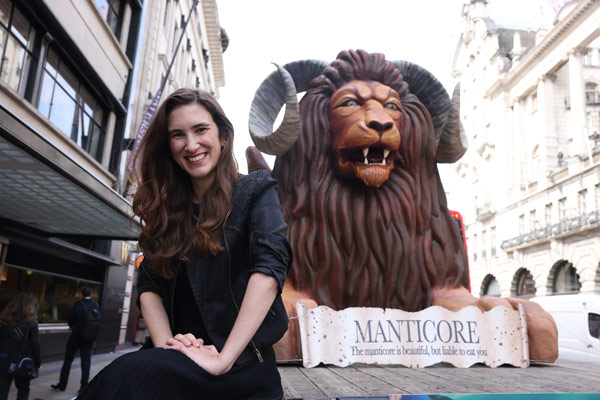
My favorite—and I think the most important—part of my research is the creatures. I have a big file on my laptop, with details of all the creatures I encountered in books, online, in archives and libraries. On my phone, I have files of photos of mythical creatures I see—on fountains, museums, even old iron railings—and I have books of notes and sketches. I also have a huge document, with details of all the islands and characters and what I know about them, which I call my Encyclopedia Glimouriana.
Do you have advice for students who are world-building as they write their own fantasy story?
For students who are creating a fantasy world of their own, first of all, I’d like to say how completely brilliant. It is such a joyful way to think about the world, and about adventure, fear, passion, creativity, delight, comedy. I would say, because fantasy can be so huge, make sure you have a few definite laws that you never break and some limits to make sure that your characters don’t find everything too easy. For instance, if you have magic, what can magic not do in your world? If characters can teleport, where can they not go?
What details about your own childhood shaped you as a writer or helped shape this series?
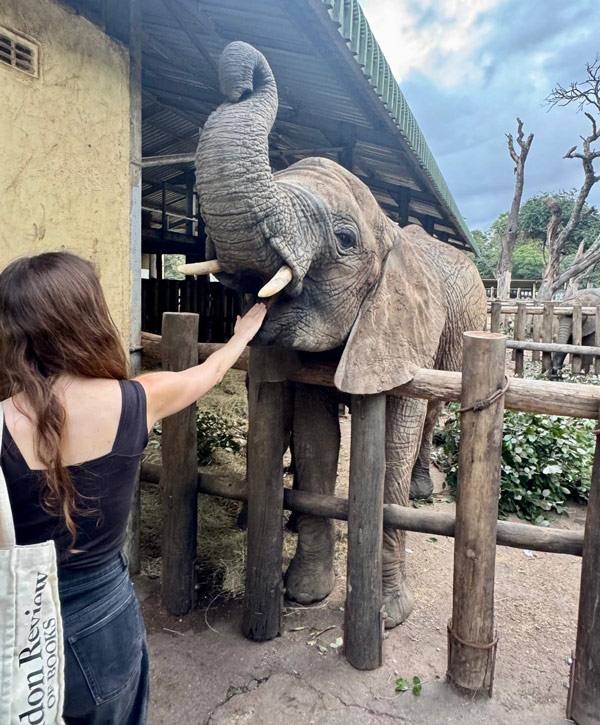
I was very lucky to spend part of my childhood in Zimbabwe, when my dad worked in international development, and it gave me access to the living world that shaped the rest of my life. I loved the fact that there were lizards in the garden, and geckos on the bathroom mirror, and occasional snakes, and hundreds of species of birds. In the first book of Impossible Creatures, the magic of the air and soil, the glimourie, is in peril; it’s in some sense a way of thinking about the perils of our own brilliant, beautiful, fragile world.
What’s your best advice for young people who have a dream that they want to pursue?
This is the most clichéd answer in the world, but I’m going to say it anyway: Don’t give up. And that means don’t give up when it’s hard or embarrassing, or you’re mocked for it, or you fail over and over. If it’s what you truly love, it will be worth pursuing, for the joy and the knowledge it gives you. And, whatever it is that is your dream, find as much out about it as you can. Whether you want to be a footballer [soccer player] or a fashion designer or a musician or an archaeologist—read and discover as much as you can about it. Nothing learned is ever wasted.
Don’t give up when it’s hard or embarrassing, or you’re mocked for it, or you fail over and over. If it’s what you truly love, it will be worth pursuing.”
Do you have any favorite anecdotes about how readers have responded to the Impossible Creatures series over the years?
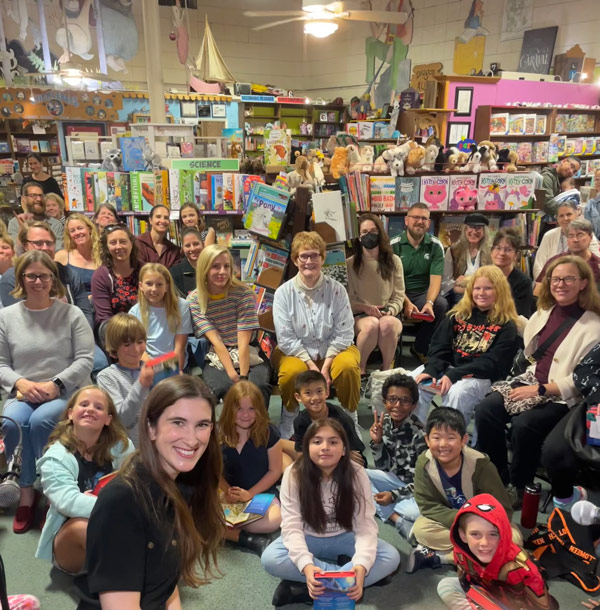
I think my very favorite has been being asked—two or three times—by very sensible, rational, cool kids: “I know that Glimouria isn’t real. Obviously, it’s made up. But—just to check—is any of it real?” I love that for some readers, the world has felt real enough for it to be worth them checking, just in case.
Why Kids’ Books Aren’t Just for Kids
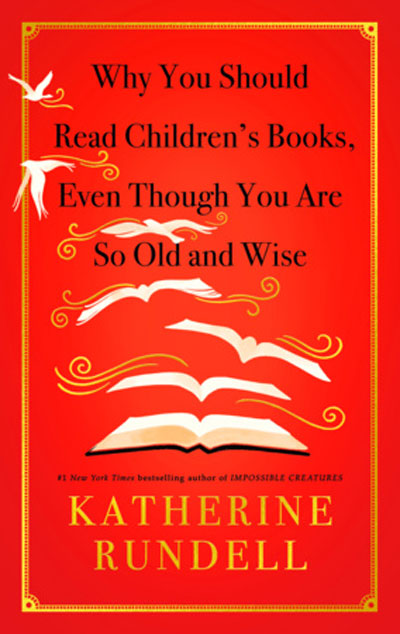
Rundell also has another new book coming out September 1: Why You Should Read Children’s Books, Even Though You Are So Old and Wise (Knopf Books for Young Readers, 2026). The title is actually an extended essay for adult readers. It makes compelling arguments about the appeal of children’s books for those who are no longer categorized as “young readers.” For adults who have lost touch with children’s books, it gives them a truly persuasive reason to rediscover the joy found in this rich world of creativity and imagination.
Here are a couple of quotes from the book:
“If hope is a thing with feathers, then libraries are wings.”
“There are fart jokes dating back to four thousand years ago.”
“Though the world burns, and there is more fire yet to come, still it will always be worth teaching children to rejoice.”
Here’s what Katherine Rundell had to say about the title:
I loved writing the part of the book about imagination; about how children’s books can help the adult reader get back to a time when their imagination was at its largest and strongest, back to the time when new discoveries came daily and the world was colossal:
“Imagination is not and never has been optional: it is at the heart of everything, the thing that allows us to experience the world from the perspectives of others: the condition precedent of love itself. We need books that are specifically written to feed the imagination, which give the heart and mind a galvanic kick: children’s books. Children’s books can teach us not just what we have forgotten but what we have forgotten we have forgotten.”
Can you share an example of a way that one of your books has been incorporated into a classroom setting?
One of the great joys of being a writer is seeing the book used as a class reader. One school I went to had covered the classroom walls in drawings of their own invented impossible creatures—it was brilliant to see the vividness of their imaginations and their talent. One boy had designed a hornet the size of a sphinx, with the teeth of a lion, which I still think about uneasily late at night.
One school I went to had covered the classroom walls in drawings of their own invented impossible creatures. … One boy had designed a hornet the size of a sphinx, with the teeth of a lion, which I still think about uneasily late at night.”
What’s your favorite part of writing for young readers?
I’ve written for both adult and child readers, and in my experience, child readers are the best readers. Their minds are fast and tough and nimble, and they send the best letters. One of my favorite ones in the last year was from a boy who objected to the choice in book one to kill one of the characters. The letter goes, roughly:
Dear Katherine Rundell,
Why did you do it?
Why? WHY?
WHYYY?
p.s. this is not hate mail.
Child readers are the best readers. Their minds are fast and tough and nimble.”
Can you tell your fans any details about your forthcoming books?
Yes! In book four, which I’m currently writing, you can expect new impossible creatures, of course—every book has fresh creatures we haven’t yet encountered—and I’m currently writing about a new form of flight that I haven’t used in the other books. I went skydiving, freefalling for a whole minute from 14,000 feet, as research for it.
What are the best ways for educators and librarians to connect with you or to follow you on social media?
I have an Instagram account which is run by my brilliant team, @katherine.rundell, that posts with news of events and publications and book recommendations.