

Books hold many powers, as author Varsha Bajaj can attest. She credits books for helping her make the cultural transition to the United States after growing up in Mumbai, India. In turn, several of Bajaj’s middle grade novels and picture books now introduce young readers to intriguing details about her country of birth.
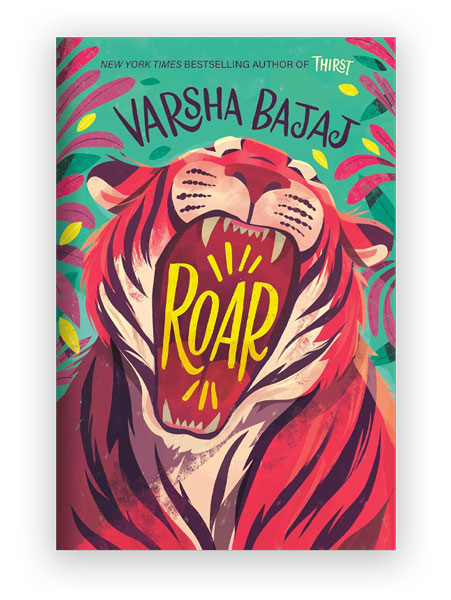
Bajaj’s newest novel, Roar (Nancy Paulsen Books, 2026), came out on May 12. The story follows Rohan, an animal-loving fifth grader from Texas, as he travels to visit his grandparents in India—where Bajaj grounds readers in the fascinating lives of the wild tigers who make the vibrant country their home. Rohan’s visit takes unexpected turns as he immerses himself in a fight to save these amazing creatures, confronting the often-complex threats they face. Ultimately, Bajaj’s story shows young people that they hold the power to help shape the kind of world they want to inherit.
Here, Bajaj talks with Lisa Bullard about helping young readers understand how complicated choices can be; her delight in books that cross boundaries; and the value of patience.
What inspired you to tell the story of Rohan and the tigers he loves?
A few years ago, I read a news article about an incredible tiger who traveled 807 miles (1,300 kilometers) across India, presumably looking for habitat and a mate. I was fascinated and inspired. It was the ultimate survival story, full of bravery, courage, and endurance.
A year later, in stark contrast, I watched a few episodes of Tiger King, a television show in which tigers were bred and raised in captivity. It was horrifying and an affront.
What was your research process like?
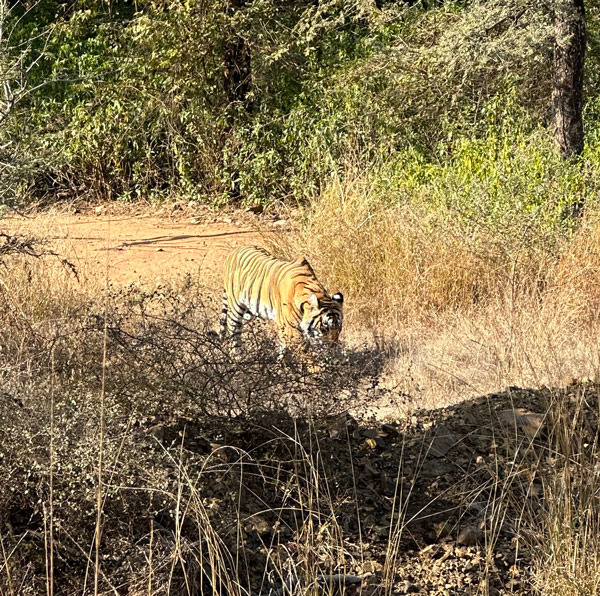
I dove into the research rabbit hole to learn more about tigers, endangered species, and the survival of species. I visited a tiger sanctuary in North India, and it completely changed the way I approached the story.
Rohan is an eco-conscious character from beginning to end, but part of what he discovers is that there are nuances to the fight to save animals and the world’s resources. For example, sometimes people seem forced to choose between survival for their family and doing what’s best for the environment. What would you like to say to young readers about this kind of complicated choice?
Growing up means understanding that most people, issues, situations, and worlds are not black and white, but there are myriad shades of gray. Most of us find comfort in dichotomies, and therefore it’s not an easy lesson. I’m always amazed at our young people and their observations; I had to therefore include the nuances, and I hope that it will lead to many conversations.
Growing up means understanding that most people, issues, situations, and worlds are not black and white, but there are myriad shades of gray.”
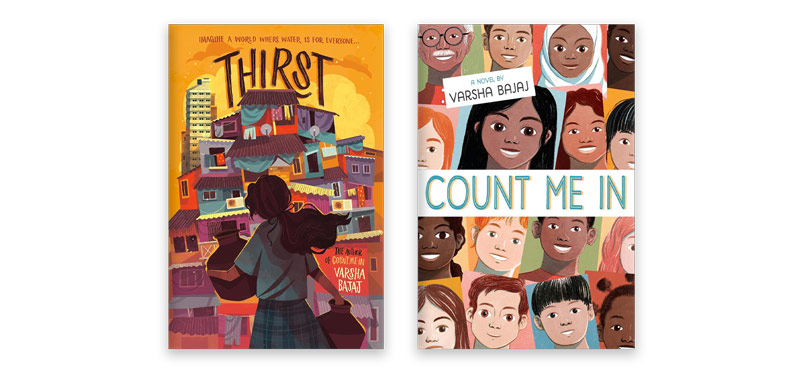
In Roar, your main character, Rohan, is from Texas and is visiting his grandparents in India. In your middle grade novel Thirst (Nancy Paulsen Books, 2022), your main character, Minni, grew up in India. What influenced your decision to make Rohan an “outsider” to India in Roar?
What an interesting question! It made me pause and think.
I was born and raised in India, but I have now lived longer in America than India. I am therefore both an insider and an outsider to India. I also have two grown children who were born and raised in America. I live with the dichotomy. When I visited the tiger sanctuary in 2023, I felt like an outsider. Everything was new and prompted many questions and research. I realized that it’s a unique world, and most readers and children would be outsiders.
An Excerpt From Roar, by Varsha Bajaj
Arya was on the hunt.
Her soft paws treaded silently, like a ghost, in the North Indian jungle she called home.
Arya’s mother had taught her well. She knew every network of paths her ancestors had used to crisscross the forest.
Crow woke up the minute he spotted Arya on the move. He flapped his dark wings and dove down from the peepal tree to follow his friend.
“Where you off to, Queen?” Crow asked.
The peepals, the palms, the banyans, the neems, and the flame trees of the forest watched as Arya paced. “I need to find the safest place in the forest.”
“The safest place?” Crow asked. “Is there such a thing?”
Arya passed by the abandoned palace built by the maharajas of the past. Their crumbling stone walls wouldn’t hide Arya from her worst enemy, the two-legged human.
“Crow, are the grasses getting thick enough to be a good shield?” she asked.
Crow spun his head and looked around at the tall grasses that sprang from the ground and camouflaged Arya as she stalked. “They should hide you, Queen.”
“Crow, maybe a cave would be safer,” said Arya.
“Perhaps,” Crow said. “There’s one on the path to the lake.”
Light was creeping through the dark, and the rising sun was beginning to paint the sky pink, when Arya spied a thicket of trees that formed a protective circle where the sun barely penetrated. Perfect for Arya.
“Arya,” said Crow, “this isn’t a cave, but it might work.”
“Maybe,” said Arya.
“Does Good Human know?” asked Crow. Arya had been carrying cubs for almost three months and recently started to bulge.
“I’ll let him see me today,” she said. Arya had known him since she was a baby. He was a human that her mother had trusted, and she trusted him too.
She waited for the fog to rise. She waited for the rattle of Good Human’s car. Soon enough he came and parked near his favorite rock, with his morning chai in a flask, a frayed blanket around his shoulders. His silver hair shone like a lion’s mane.
“Oh, namaste, Arya!” he said when Arya emerged. “No one’s seen you for days. You’ve been hiding.”
Arya leapt over to her favorite space: a stone structure with a canopy, like a large umbrella built of concrete. Centuries ago, a human queen and her ladies might have taken shelter from the rain or the sun. Or the king might have stopped there to eat his afternoon meal while on a hunt for one of Arya’s ancestors.
When Arya leapt, the human’s keen eyes noticed her belly bulge.
“Wah! Wah!” he said, finishing his chai and bowing to Arya.
Crow, who was perched on a nearby tree, approved of his bow. She was the queen, after all.
Good Human packed his things and, with a smile, waved at Arya as he started his vehicle. “Well done, Arya. When I tell my wife, she will be so thrilled that she’ll dance and make us ladoos.”
After Good Human was gone, Arya stretched and let the rising sun soak into her striped fur. Her hunt for a place to birth her cubs wasn’t over yet, but she would rest here today and prowl some more in the shadows of the night.
Crow tucked his head in his neck and rested too, perched above in the fronds of the flame tree.
Excerpted from Roar by Varsha Bajaj. Used by permission of the publisher. Copyright © 2026 by Varsha Bajaj. All rights reserved. No part of this excerpt may be reproduced or reprinted without permission in writing from the publisher.
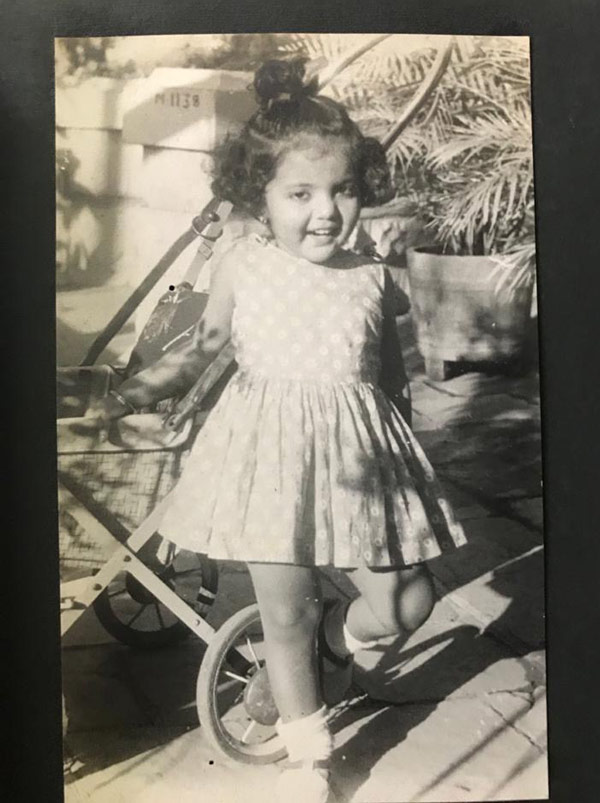
What details about your childhood would you like to share with young readers? In what ways did those years shape you?
I didn’t have access to the kind of libraries we have in America, with beautiful children’s sections, but I found books regardless. I read cross-culturally because back then the children’s publishing industry in India was still emerging. It gave me access to a global perspective. My grandfather would sit in his rocking chair on the verandah of our house and read aloud from Jane Austen and P.G. Wodehouse books, and I fell in love with the magic and poetry of the written word.
I fell in love with the magic and poetry of the written word.”
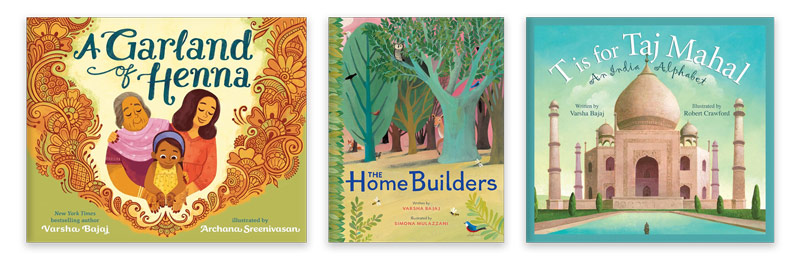
Do you have a favorite anecdote about how a young reader has responded to one of your books?
A young girl in Westchester County, New York, ran up to me after a presentation and whispered, “Do you think Minni [from Thirst] would be friends with me?” That question was so innocent and pure and proof of the power of empathy and the fact that books cross boundaries.
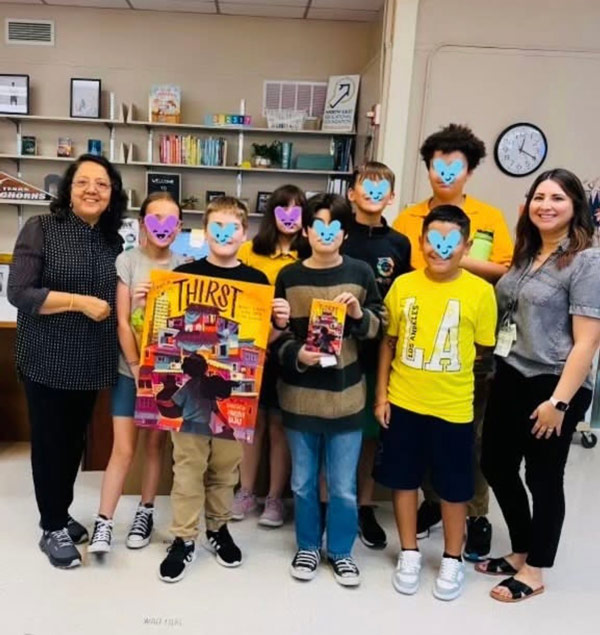
What are some of the ways that your books have been incorporated into a classroom or community setting?
We don’t see Minni’s face on the cover of Thirst, and a teacher had her class recreate the cover of Thirst with Minni facing us. There were as many depictions as readers.
I could literally go on and on. Kids have raised money for water charities, and in other schools they’ve walked a mile carrying water after reading Minni’s story.
What would you suggest to young people who have a dream they want to pursue?
Take baby steps each week or each day. Educate and align yourself with role models who can guide and inspire you. Following dreams takes time: it’s not a sprint, but a journey. Don’t be discouraged if the road is circuitous or has many obstacles.
Following dreams takes time: it’s not a sprint, but a journey.”
What’s your advice for young people who want to create their own stories?
If young people want to write, they must read, read, and read some more and believe in themselves. The best writing requires honesty and digging beyond the obvious. In a world of AI and quick solutions, writing requires diligence and patience. I would also tell young writers to be kind to themselves. Please do not compare your first draft or early efforts to a finished book.
I would also tell young writers to be kind to themselves. Please do not compare your first draft or early efforts to a finished book.”
What’s your favorite part of writing for young readers?
I enjoy introducing my readers to new worlds; being their travel guide of sorts. They’re so hungry to travel through books.
I love meeting my readers and being among them. It energizes and inspires me.
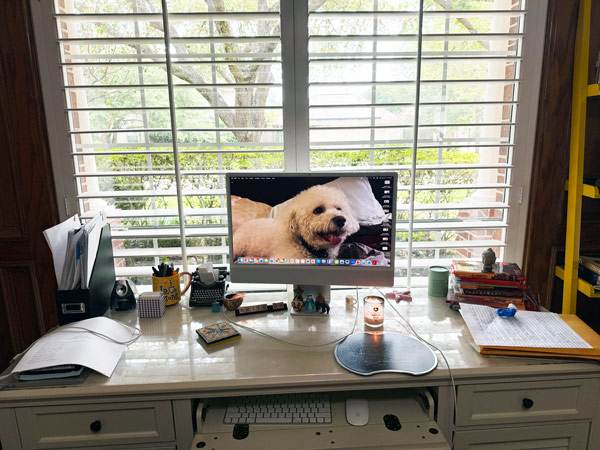
Can you share any details about your forthcoming books?
I have three picture books in the pipeline, all to be published by Nancy Paulsen Books:
- Go Tuk Tuk Go!, illustrated by Bao Luu (2027)
- Raja’s Journey, illustrated by Chaaya Prabhat (2028)
- All the Gardeners, illustrated by Grace Easton (2029)
What are the best ways for educators and librarians to connect with you or to follow you on social media?
My Instagram handle is @varshawrites
On Bluesky my handle is varshab.bsky.social
On X my handle is @varshabajaj
Librarians and educators can also write to me from my website, www.varshabajaj.com.
Click here to read the news article that inspired Varsha Bajaj to write Roar.